



|
|
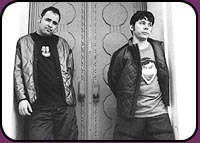 |
The result of their efforts is called Tweekend, and it sets out to scramble what everyone thought they knew about The Crystal Method. The bass-fortified, hard-rolling techno concoctions will still get the club kids moving, while the muscular hip-hop beats and fluid funk melodies have been beefed up with an array of loud-and-soft rock dynamics. "This one is definitely a darker, more patient, more sparse album," Jordan says. "It has bite." It's a direction that was only hinted at with blockbuster singles like "(Can't You) Trip Like I Do" and "Busy Child." Tweekend takes everything that is great about Vegas and makes it even better. "We had every opportunity to make the record we wanted to make and take the time to make it," Kirkland says. "We wanted to come up with something that was bigger, better and badder than the last thing." Simple enough in theory, but once the band got down to business, the project became formidable. The temptation to get the sound of every high-hat, every electric crackle, every voice just right in the mix was overwhelming, as the band relentlessly worked and reworked each song to throbbing perfection. The title was a given. "We were just constantly tweaking the songs and mixes," Jordan says. "We were almost thinking it was going to take another five years to get it done." To help carry their vision through, The Crystal Method invited a select group of friends and peers to contribute to the songs on Tweekend, including Stone Temple Pilots singer Scott Weiland and Rage Against The Machine guitarist Tom Morello, who had such a good time he ended up co-producing four tracks. DJ Swamp (Beck) lent his dynamic turntable skills to "Name of the Game," while multi-instrumentalist/ producer Jon Brion (Fiona Apple, Aimee Mann) reprised his role from the first album, where he played on "Bad Stone," by collaborating on the new track "Over the Line." Weiland sings and plays guitar on "Murder." "The Scott Weiland collaboration was done using full-on modern technology," Jordan says. "We had talked about working together, but the timing of the situation was off. So we sent him some tracks, he picked out the one he liked, he did his parts, sent those files back to us, and we redid the track all around his parts. The effort he put in is there, but we haven't seen him face-to-face in two years." Morello was so into the project that he cleared his busy schedule with Rage Against The Machine to put in serious studio time with The Crystal Method. Apart from his production duties, he ended up playing guitar and singing talk-box vocals on three tracks." "He whipped us into shape," Kirkland says. "He's very focused. He just appears in our studio, sets up all this stuff and gets straight to work. If he had the time, he would have produced more with us. He told us, 'I would be in your band if you guys only worked faster.'" Morello also co-wrote and co-produced "Name of the Game," which is the first single off Tweekend. The song features the distinctive vocal skills of Styles of Beyond member Ryu, who the band happened upon while on a search for undiscovered talent in the Los Angeles area. Growing up in Las Vegas provided a unique coming-of-age experience for Kirkland and Jordan, with an early musical diet consisting of artists like Led Zeppelin, Stevie Wonder, Motley Crue, Depeche Mode and AC/DC. Kirkland still recalls taking guitar lessons from hair rocker Mark Slaughter before his band hit the big time in the mid-80s. Jordan, meanwhile, immersed himself in new music by DJing and becoming music director at KUNV, the college radio station at UNLV. Once the duo got together and found some common musical ground, it didn't take long to realize that a desert gambling resort was no place to launch a serious career in cutting-edge dance music. In 1992 they relocated to Los Angeles, where they scored their first underground club hit with a pulverizing sample-based track called "Now Is the Time." A buzz erupted, and the major labels started courting. It took a little deliberation before the group signed up with Geffen subsidized Outpost Recordings, which later folded into Interscope. "Everything we've gone through shows up in the music," Kirkland says. "This album is definitely better than the first, so we aren't too worried about a sophomore jinx."

